Psychology in investing
The first step to investing successfully is to educate yourself. It is often said that fundamental analysis accounts for around 20% of the outcome, while psychological preparation and discipline account for the remaining 80%. Beyond technical knowledge, the decisions you make in the face of market and portfolio swings will, in all likelihood, be what determines the difference between mediocre results and consistently beating the market.
Prices are nothing more than the reflection of the aggregate behaviour of all participants. The allegory of Mr. Market, put forward by Ben Graham, illustrates this well: the market is made up of more and less skilled investors, but they all share something in common — they are human, with their biases and emotions. News, both positive and negative, amplifies those reactions. That is why learning to manage your own behaviour is as important as analysing companies.
It is worth remembering that there is always something to worry about in the market. In fact, often the greater the fear, the greater the opportunity can be.
The best example of the market’s emotional cycle:
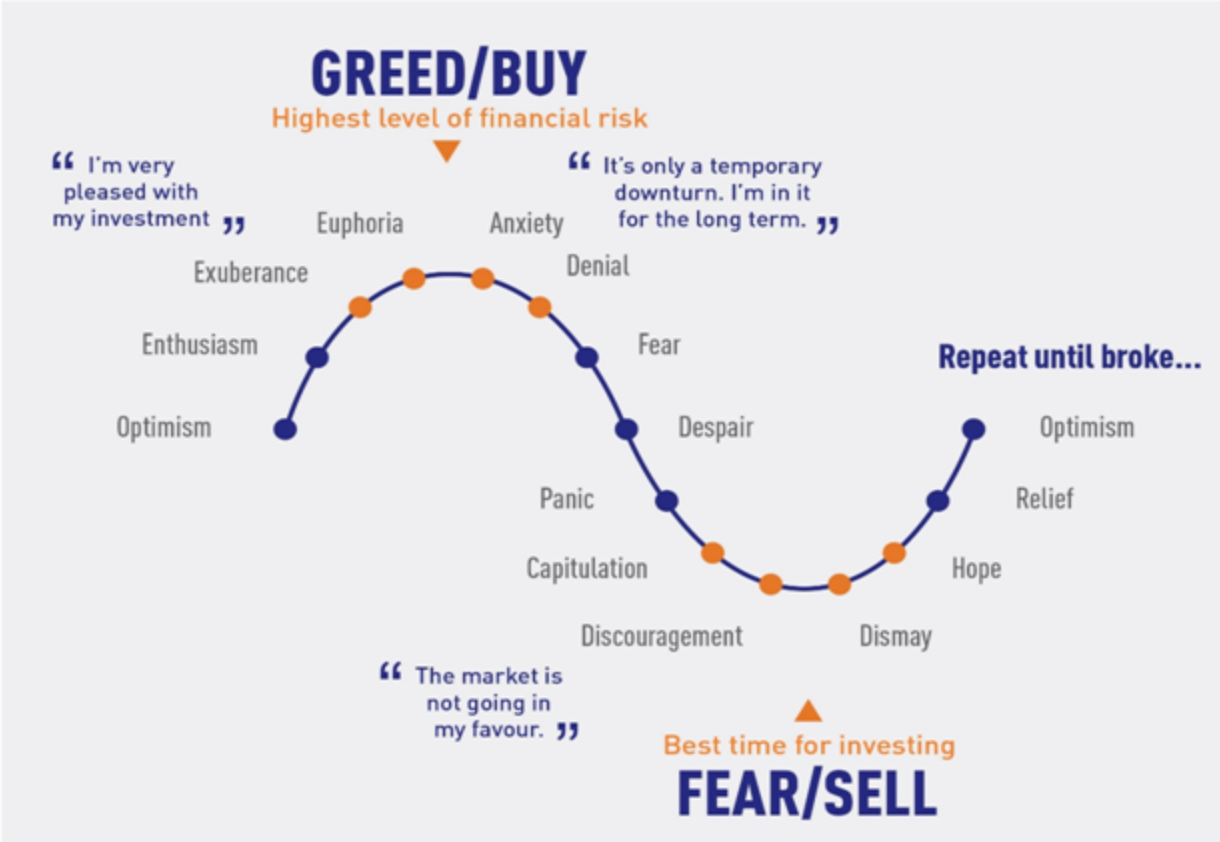
Source: Mirae Asset – Importance of investor behaviour in market correction
Rules of behaviour
1. Prepare your plan
Always invest with a defined strategy. In times of volatility, emotions take over; the plan is your anchor.
Define in advance what you will do if a stock falls 20%, if it rises 50%, or if the thesis changes. Make decisions when you are calm and rational, and commit to executing them when the time comes. Written rules, conditional orders or alerts help avoid impulsive decisions.
Discipline does not eliminate fear, but it keeps it under control.
2. Don’t freeze
After an investment mistake, it is normal to freeze and question your knowledge. What matters is not avoiding every error, but surviving them and learning.
What’s lost is lost. Analyse what went wrong, adjust the process and move on. Many losses in a crisis are latent: the market may be slow to recognise value. March 2009 or March 2020 were moments of extreme panic. If you were not willing to buy then, perhaps the problem was not the market, but your preparation.
3. Don’t trust your confidence
Most professionals consider themselves better than average. Statistically, that is impossible.
Only a minority consistently beat the market over the long term. We tend to overestimate our abilities and to believe we control more than we actually do. The illusion of control is powerful.
Always ask yourself the uncomfortable question:
- Why should I NOT make this investment?
Actively look for the weaknesses in your thesis.
There is a technique called “Kill the company”. Bruce Berkowitz (Fairholme Capital Management) is known for this approach: subject each idea to an imaginary “death”. Some typical causes of company “death”: they don’t generate free cash flow, excess debt, incompetent or dishonest management, misuse of capital or metric fraud.
4. Don’t outsource your judgement to “gurus”
Experts get it wrong too, and often show more overconfidence than the average investor.
Listen, learn, but do not replace your judgement with anyone else’s. Independence of judgement is a competitive advantage. You are competing mainly against your own emotions, not against other investors.
5. Filter the noise
We live saturated with information. Much of the “financial circus” exists so that you trade more and someone collects fees.
More information does not mean better decisions. Consume only information that is relevant, verifiable and useful for your process.
6. Seek criticism, not applause
Surrounding yourself with people who think like you is comfortable, but dangerous.
Seek contrary opinions and stress-test your thesis. If you cannot defend it against solid arguments, it may not be a good investment.
7. Change your mind when the facts change
Cognitive dissonance pushes us to defend our decisions even when reality contradicts them.
Revising your stance in the light of new information is not weakness; it is professionalism.
8. Do nothing
Disciplined inaction is an underrated advantage.
Good companies do not change radically from one day to the next.
Sometimes the best trade is not to trade.