Investing in ETFs
An ETF (Exchange Traded Fund) or exchange-traded fund is an investment fund that trades on the stock market and is bought and sold like a share.
It combines two things: the portfolio of assets of a fund and the trading of a security in real time.
The first significant ETF dates from 1993 (S&P SPDR, linked to the S&P 500). In 1997 iShares brought the format to European, Asian and American indices; today the market exceeds 15 trillion USD in assets and there are more than 12,000 ETFs worldwide, with ~23% annualised growth since 2003.
Main characteristics
| Aspect | What it offers |
|---|---|
| Accessibility | Same mechanics as with shares (through the broker). |
| Flexibility | Buy and sell at any time during the session, without waiting for the close. |
| Transparency | Portfolio composition, net asset value and prices in real time. |
| Liquidity | Highly liquid products; each ETF usually has market makers providing liquidity. |
| Cost | Fees (TER) generally lower than those of most investment funds. |
Types of ETFs
- By underlying: equities (indices, sector, FAANG…), bonds, commodities (gold, oil), currencies.
- By management: passive (replicate an index; e.g. SPY, QQQ) or active (e.g. ARKK).
- By features: sector (REITs, robotics…), inverse (short) or leveraged (CAUTION with inverse and leveraged: they are high-risk products).
There are more than 2,400 ETFs accessible from Europe and more than 3,000 in the US. These sites make it easier to search for ETFs:
- justetf.com - Europe
- etfdb.com - US
ETFs vs investment funds
| Criterion | Investment funds | ETF |
|---|---|---|
| Returns | ~91.6% do not beat the benchmark; they can outperform in crises | Depends on the index; S&P 500 ~8% per year long term (with dividends) |
| Costs | US: typically 2% + 20% performance; Spain: 1–2% + 9% | Approx. 0.05–0.3%; in Europe access to US ETFs can be more expensive |
| Liquidity / flexibility | Depends on the fund; sometimes restrictions | Buy/sell during the session (except very niche ETFs) |
| Transparency | Portfolio with a delay (e.g. quarterly, 45 days) | Portfolio, NAV and volume in real time |
| Tax (Spain) | You only pay tax on redemption; tax-free transfers between funds | Like shares: you pay tax on sale; no tax-free transfers |
Advantages and disadvantages
Advantages: low cost, economic diversification (broad or niche portfolio), returns aligned with the index (avoiding the handicap of 91.6% of active managers who do not beat the benchmark), in-session trading and daily transparency.
Disadvantages: in Europe access to US ETFs requires UCITS replicas or alternatives (e.g. options); no tax-free transferability; you follow the index (no active management); in very sectoral or concentrated ETFs diversification is limited; besides the TER, the bid-ask spread can have an impact, especially over the short term.
Dividend ETFs
They can be distributing (Dist) or accumulating (Acc).
From a tax perspective accumulating are usually more efficient; many investors prefer distributing for periodic passive income.
Decoding an ETF
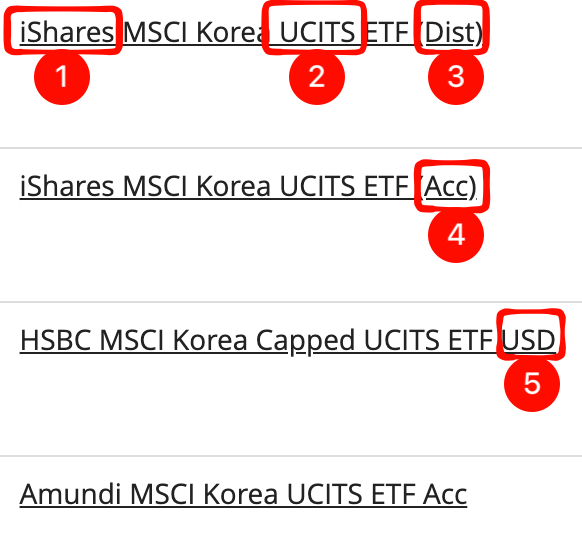
- Fund manager
- Investable from Europe
- Distributing dividends: means that the dividends received from the companies whose shares the ETF holds are paid out to the ETF holders.
- Accumulating dividends: means that the dividends received from the companies are automatically reinvested.
- Currency in which the ETF is traded.