Stock market sectors
Stock market sectors or markets are categories that group companies according to the type of economic activity they carry out. In other words, depending on how a company makes money, it will belong to one sector or another.
It should be noted that there is no international consensus that everyone follows to determine whether a company is part of one sector or another. Each country with a stock market usually has its own regulators, and these determine how companies listed on that market are categorized.
Sector categorization
The regulator of the US stock market is the SEC (Securities and Exchange Commission). They have a system called SIC – Standard Industrial Classification, created in the 1930s-1940s and is in active update.
You can access the SEC’s Industrial Classification (SIC) list at this link: https://www.sec.gov/search-filings/standard-industrial-classification-sic-code-list
Each regulator in each country has its own “standards” and classifications. In the Spanish stock market, the regulator is the CNMV.
It is somewhat complicated to find the information at the CNMV, since it is supposed to update the lists with the sectors each quarter, different from how the US does it, but here are some links:
- https://www.cnmv.es/portal/consultas/ee/distribucionporsectores?lang=es
- https://www.cnmv.es/Portal/Publicaciones/Estadisticas-Cotizadas-IFI
- https://www.cnmv.es/DocPortal/Estadisticas/Cotizadas/IFC_1Semestre2024.pdf
Personally, I find it clearer how the BME (Bolsas y Mercados Españoles) expresses it.
Here is a link:
There is another very relevant classification, developed jointly by MSCI and S&P in the late 1990s, whose main objective was to resolve the lack of uniformity that existed until then in the classification of companies by sectors and industries. Before this standard, each analyst, institution, or data provider could use different criteria, which made it extremely difficult to compare companies, markets, and regions.
To solve this problem and establish a common language globally, GICS (Global Industry Classification Standard) was created. This system allows classifying any company coherently according to the economic activity that actually generates most of its revenue. (as a general rule 60%)
GICS is structured hierarchically, which facilitates progressive analysis from a general view to a very detailed level. It consists of four levels:
- Sector: is the broadest level and groups large areas of the economy (for example, technology, health, or finance).
- Industry Group (or Primary Industry): subdivides each sector into groups with similar economic characteristics.
- Industry: further refines the classification, grouping companies with very similar business models.
- Sub-Industry: is the most specific level and allows precisely identifying the exact type of activity the company performs.
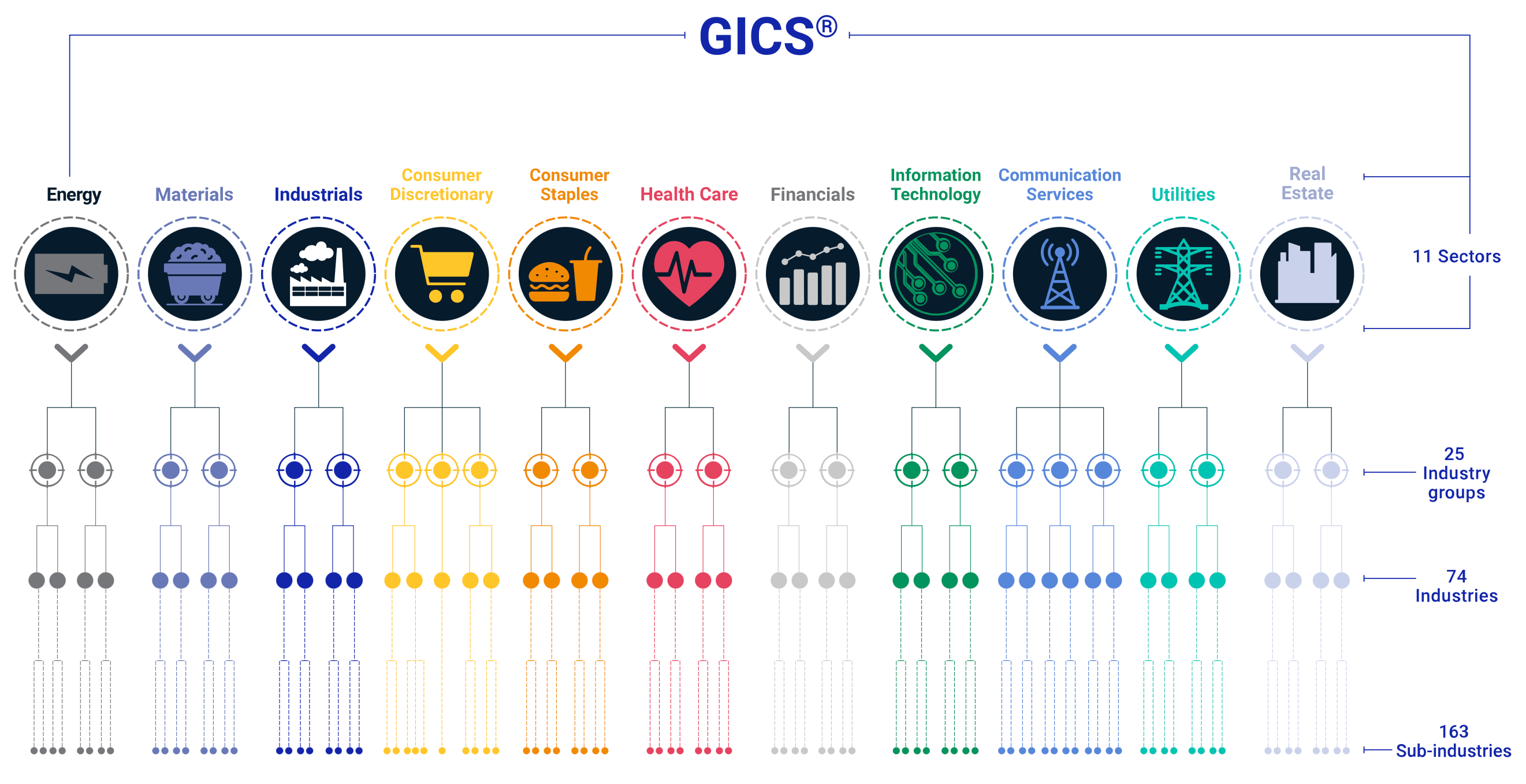
Thanks to this structure, analysts can compare companies consistently, evaluate sector trends, build diversified investment portfolios, and conduct economic studies with greater rigor. The GICS standard is widely used by analysts, fund managers, and financial platforms worldwide, and is considered one of the most reliable, practical, and accepted systems within modern financial analysis.
Below, you will find a link to delve deeper into this methodology (the content is in English).
Fun fact
The GICS system also has coding, for example this would be the code for the sector to which Alphabet belongs: 50203010
And it would be broken down as follows,
- Sector: 50 - Communication Services
- Industry Group: 5020 - Media & Entertainment
- Industry: 502030 - Interactive Media & Services
- Sub-Industry: 50203010 - Interactive Media & Services
How do I know which sector a company belongs to easily?
You can do it in several ways, I’ll give you two examples, using the company Alphabet (Ticker: GOOG or GOOGL):
Using the search engine
Open your browser and type the following: “
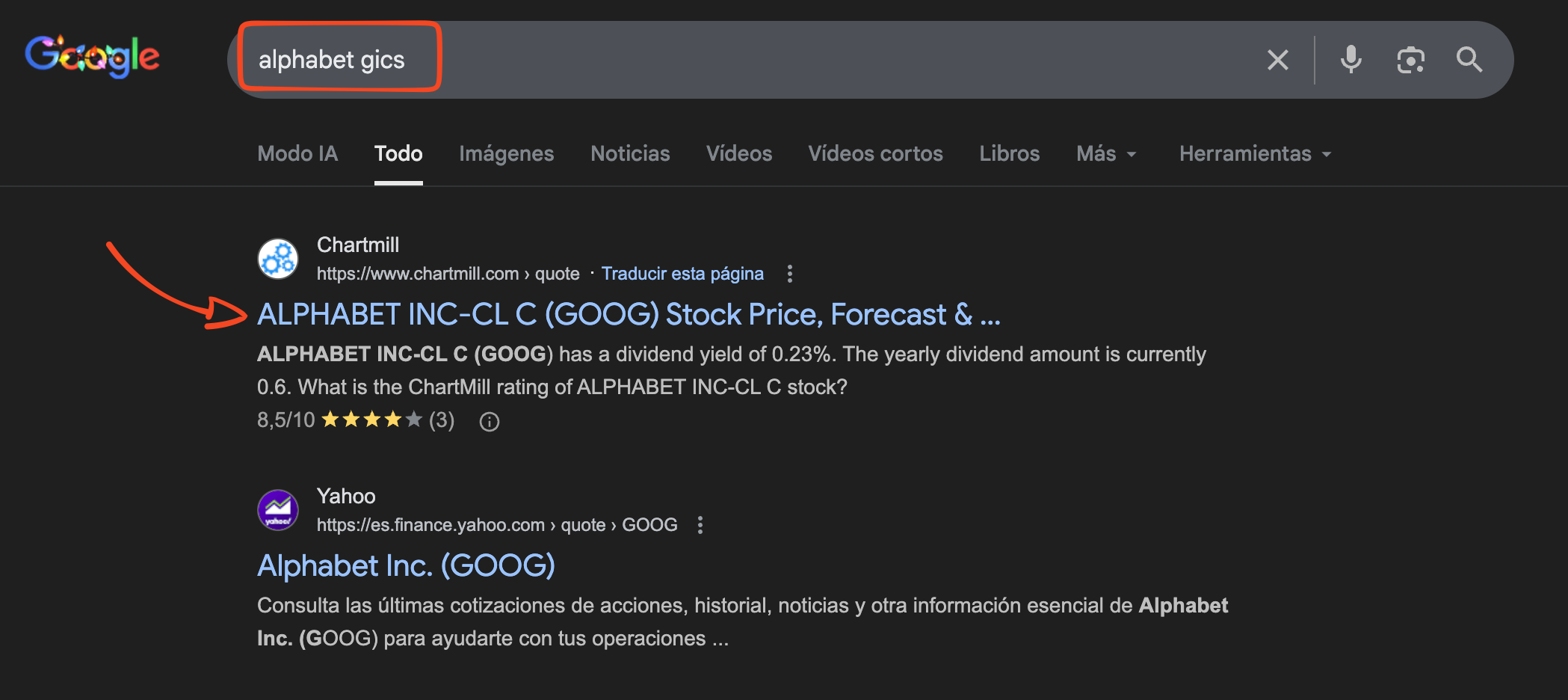
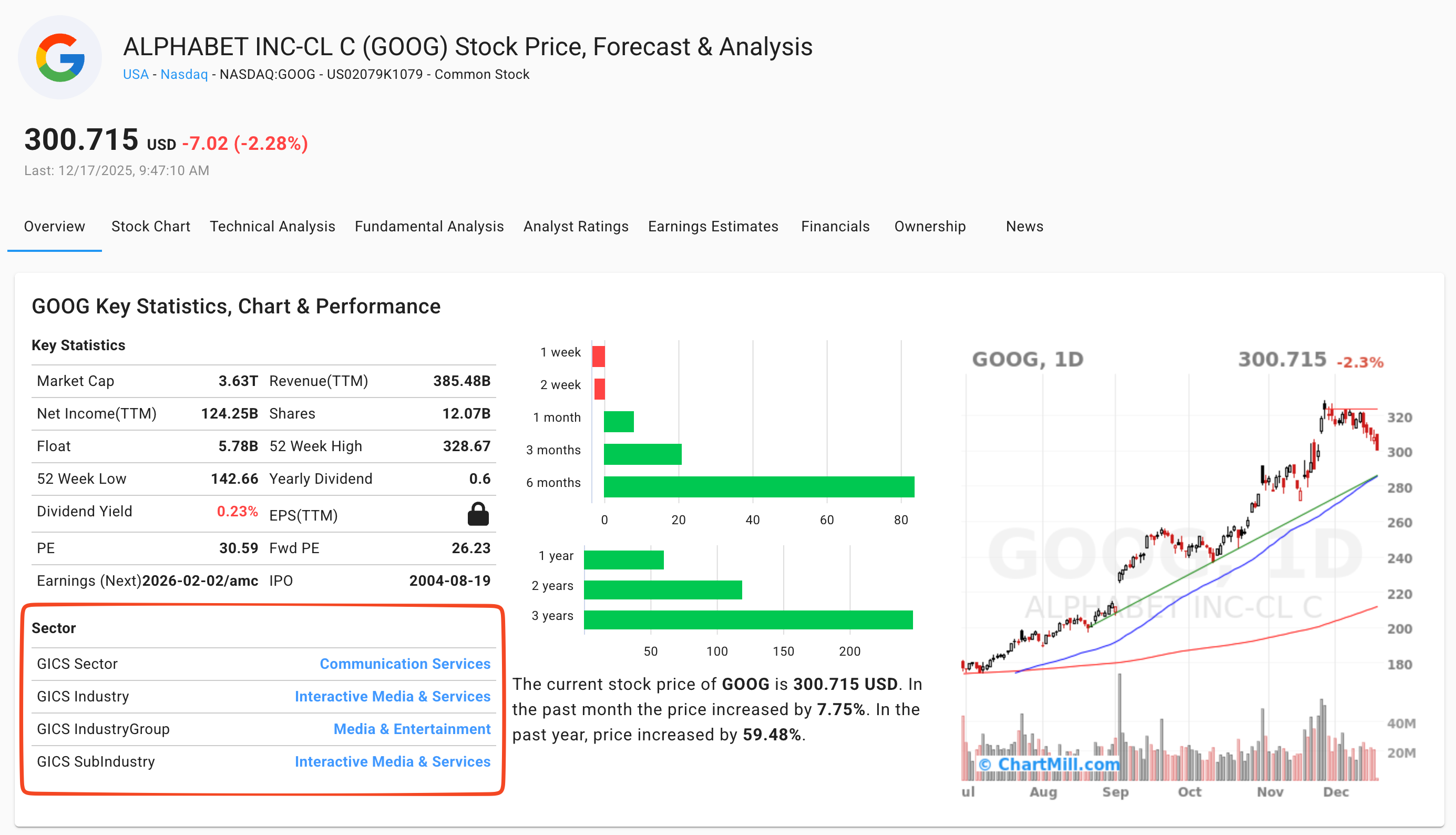
For example, according to GICS, Alphabet belongs to the Communication Services sector, and not Technology. Why? Alphabet’s main revenue comes from subscriptions to programs like YouTube Premium, YouTube TV, NFL, etc.
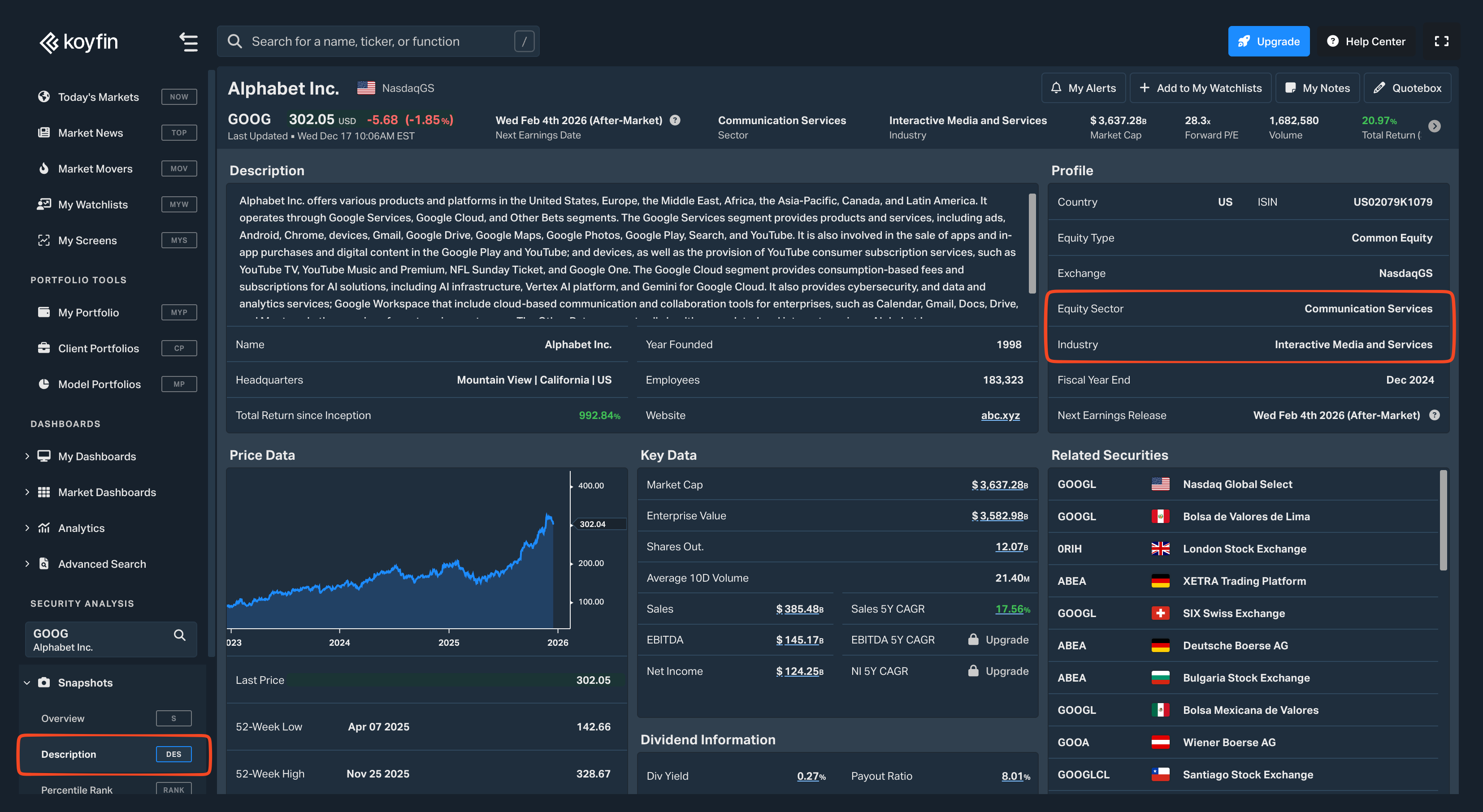
From Koyfin
Although the explanation of the Koyfin tool is later, I want to show you that you can also find that information from their portal