Market Perspectives
The two market perspectives:
- Technical Analysis
- Fundamental Analysis
There are many discussions about which market analysis method is better, these debates or discussions have existed at least since the 1930s-1940s.
The debate itself is absurd: it’s like arguing whether the car or the plane is better. The answer is: it depends. It depends on whether you want to go to the supermarket or travel long distances in a short time.
The question should be: in what situations should Technical Analysis be used and in which ones Fundamental Analysis? To answer this question, let’s first define both concepts.
Technical Analysis
It is the study of “market action,” primarily through the use of charts, for the purpose of predicting future price trends.
The term “market action” includes the three main sources of information available to the technical analyst: price, volume, and open interest (open interest is used in futures and options).
The term “price action,” which is also often used, may be too limited, since most technicians consider volume and open interest as an integral part of their market analysis.
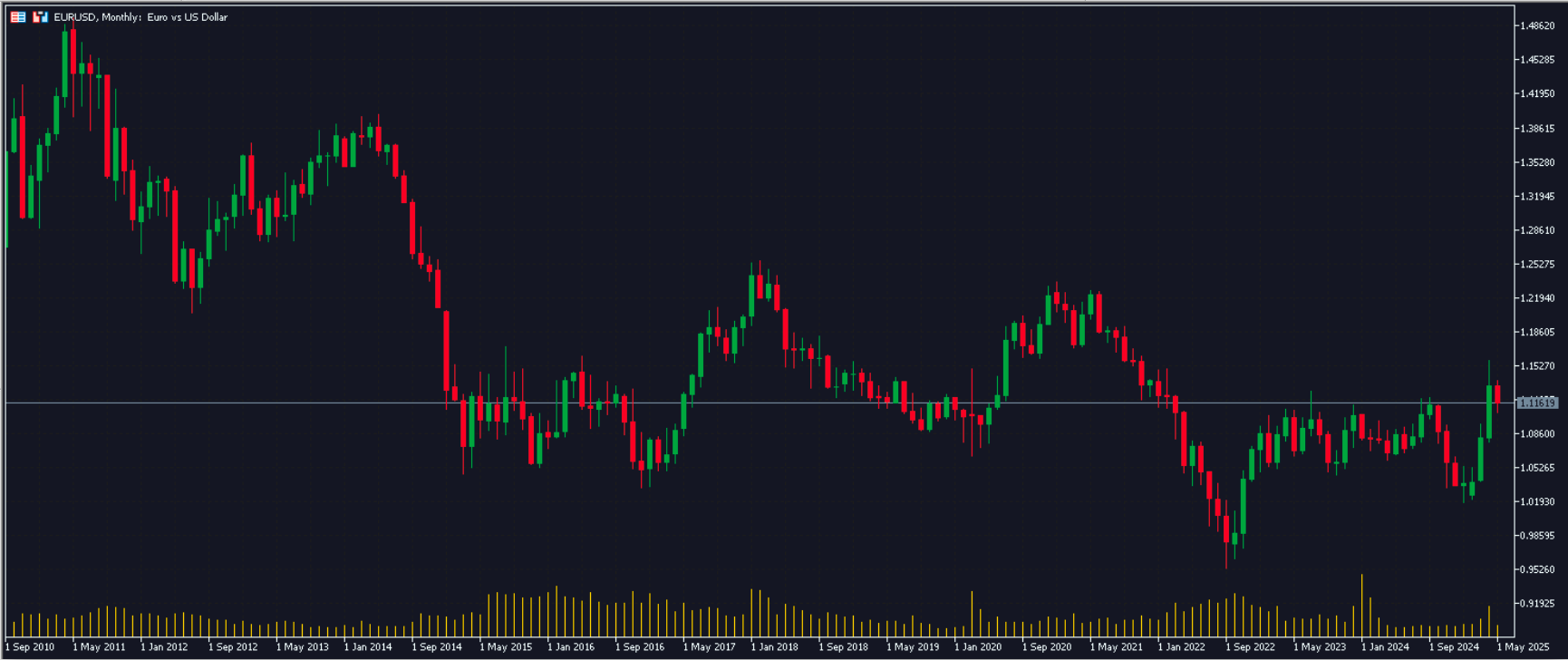
Example of EUR/USD chart on monthly chart. MT5 platform (MetaTrader 5)
Philosophy or foundation
There are three premises on which the technical approach is based:
- Market action discounts everything.
- Prices move in trends.
- History repeats itself.
1. Market action discounts everything.
The statement “market action discounts everything” is probably the cornerstone of technical analysis. Unless the meaning of this first premise is fully understood and accepted, everything else loses meaning.
The technical analyst believes that anything that can affect the price, whether at a fundamental, political, psychological, or any other level, is already reflected in the market price.
Therefore, the study of price behavior is all that is necessary. Although this statement may seem presumptuous at first glance, it is hard to refute when its meaning is truly understood.
2. Prices move in trends.
The concept of trend is absolutely essential to the technical approach.
The entire purpose of graphically representing price action in a market is to identify trends in their early stages of development, with the goal of trading in the
same direction as those trends.
3. History repeats itself.
Much of technical analysis and the study of market action is related to the study of human psychology.
Chart patterns, for example, which have been identified and classified over the last hundred years, represent figures that appear on price charts.
These figures reflect the bullish or bearish psychology of the market. Since these patterns have worked well in the past, it is assumed that they will continue to work well in the future.
They are based on the study of human behavior, which tends not to change over time. Another way to express this premise (history repeats itself), is to say that the key to understanding the future lies in the study of the past, or that the future is nothing more than a repetition of the past.
Fundamental Analysis
We can define it as the discipline that seeks to determine the “intrinsic value” of an asset through a thorough examination of its economic and financial fundamentals. The ultimate goal is to discern whether the current market price adequately reflects this underlying value, in order to make informed investment decisions.
Within Fundamental Analysis, two main approaches are distinguished: Value Investing, which focuses on identifying companies whose market price is below their intrinsic value, and Growth Investing, which seeks companies with high potential for future growth, regardless of their current valuation. Both styles represent distinct but valid philosophies for building an investment portfolio.
I will focus on Value Investing.
Philosophy or foundation
Fundamental analysis is based on three conceptual pillars:
- Each asset has an intrinsic (real) value.
- The market tends to correct its valuations in the long term.
- Exhaustive analysis is required to unravel intrinsic value.
1. Each asset has an intrinsic (real) value.
This premise is the foundation on which all fundamental analysis is built. It implies that, beyond the daily fluctuations of the market, there is a fundamental value, rooted in the economic and financial characteristics of the asset in question. The fundamental analyst is dedicated to unraveling this underlying value, considering it the true measure of its worth.
Important components of fundamental analysis:
To determine this intrinsic value, the fundamental analyst relies on a thorough examination of various elements:
Financial Statements: The detailed analysis of the balance sheet, income statement, and cash flow statement provides insight into the financial health and past and present performance of a company.
Company Management: The quality, experience, and vision of the management team are crucial factors that can significantly influence the future of the company and, therefore, its value.
Industry Analysis: Understanding the sector in which the company operates, its growth dynamics, existing competition, and possible barriers to entry helps contextualize the company’s performance.
Macroeconomic Environment: Factors such as overall economic growth, inflation, interest rates, and government policies can have a significant impact on asset value.
2. The market tends to correct its valuations in the long term.
This idea postulates that, although in the short term the price of an asset may be influenced by a multitude of factors (market sentiment, news, speculative supply and demand), in the long term, the market will tend to recognize and adjust the price towards its true intrinsic value. Fundamental investors seek to capitalize on these temporary discrepancies between market price and intrinsic value.
3. Exhaustive analysis is required.
To be able to identify that intrinsic value and possible market deviations, fundamental analysis demands deep and detailed research. It is not based on superficial observation of prices, but on understanding the fundamental factors that drive the value of an asset. This involves the collection and analysis of a large amount of economic and financial information.
In essence, fundamental analysis is a methodology that seeks to invest with a deep understanding of underlying value, trusting that, in the long term, the market will recognize this valuation.
Can both analyses be used at the same time?
What theory says
It makes a lot of sense and is a common and recommended practice. The combination of both approaches can provide a more complete and robust perspective for investment decision-making.
Fundamental analysis can help determine what to buy (identifying assets with value), while technical analysis can assist in when to buy or sell (optimizing the timing of the trade).
For example, an investor could use fundamental analysis to identify a solid company with long-term potential that they consider undervalued. Then, they could employ technical analysis to look for favorable entry points, waiting for confirmation of an uptrend or a pullback to a key support level.
In financial jargon this is called “Market Timing.”
What practice shows us
It doesn’t make sense to combine these two approaches (doing Market Timing). Think: what we want is to create long-term wealth. What does it matter, over a period of 10-15 years, having found the perfect entry that may fluctuate between 2 and 10 euros? By waiting for the perfect moment we can miss a wonderful opportunity.
There are various studies that demonstrate this. For example, one that is publicly available and in Spanish is one conducted by Indexa Capital. This study focuses on calculating the gains of two investors: the first has incredible luck and always buys at the best price (cheapest), and the second has the worst luck and buys at the worst price (most expensive). How do you think they will end up?
- Link to the study where they describe it more specifically: https://blog.indexacapital.com/2019/05/27/bob-the-timer/
As we can see, the luckiest investor in the world and the least lucky one, in the long term they don’t differ much: both have earned considerable sums of money.
Another point to highlight is the importance of staying invested. Psychologically, in some way technical analysis invites us to constantly enter and exit the market. This study demonstrates once again that they are completely different tools and ways of seeing the market. To even think about mixing them, a high level of psychological preparation and knowledge is needed.
I share another study with you, which emphasizes the importance of staying invested during the worst moments of the market, since as indicated in the article, “there will always be something to worry about.”
- Link to the article by JP Morgan: https://www.chase.com/personal/investments/learning-and-insights/article/tmt-february-eighteen-twenty-two
Moral/Summary
In theory, combining the two types of analysis seems very attractive and professional, but in practice we see that it doesn’t make sense if our vision is to invest and create long-term wealth without major headaches.
The real danger? Staying out of the market waiting for the ideal moment or getting out of the market in panic.
Let’s see then where it makes sense to use one tool or the other.
When to use Technical Analysis or Fundamental Analysis?
Knowing that the two analyses are not compatible, let’s see in what situations they are useful.
When to use: Technical Analysis
With a much shorter time horizon than fundamental (from seconds to, at most, a couple of months), its main use is in derivative financial instruments, which are used mainly to speculate on the price of underlying assets. For example, one of the financial instruments in which it is most used is CFD (Contract for Difference) or Futures.
These are products that are normally leveraged, which means there is a high probability of losing all your money. In fact, if you enter a broker that trades CFDs and has decent regulation, it must show an alert message on its page indicating that more than 70% of people lose their money.
When to use: Fundamental Analysis
Much longer time horizons, from 5 to 20 or 40 years and even more.
What does this allow us? Not everyone has to like the world of investments and finance, so a fundamental analyst can perfectly dedicate themselves to other things
while making their wealth grow. Hence, this is the best option for those seeking financial freedom.
Fundamental analysis focuses more on stocks, ETFs, and index funds (although there are many more financial instruments that we can analyze from this perspective, we will see them in other sections).
If you are new to the world of finance, from my humble point of view, I would start with Fundamental Analysis, easier to understand and, if done correctly, with lower risk (the fact that you are not leveraged already counts a lot). If later you want to delve deeper into the field of finance, then study Technical Analysis.
But I want to make it clear: these two techniques cannot and should not be mixed (at least at the beginning), they are tools intended for totally different functions, although at first glance they may seem to serve the same purpose.
Now you know the two points of view that exist when analyzing the stock market. Remember that in these notes I focus on Fundamental Analysis, exactly on the Value Investing technique. But here the rules don’t end. We have to talk about the following points. The last one, as you will see, is completely personal and wouldn’t fall into the so-called “rules,” but I would like to mention it in this section:
- Stock market sectors.
- Markets and hours.
- Volume and market capitalization.
- Financial Instruments (Stocks, ETFs, Index funds, etc)
- Tools of a Fundamental Analyst (Tickr, Notebook LLM, and Koyfin)